The short version: You cannot buy your way to YouTube monetization. The Partner Program's 4,000 valid public watch hours have to be organic. Watch time from Google Ads is explicitly excluded and does not count toward that number. I learned this the practical way this week, running two YouTube ad campaigns and watching one of them spend real money for almost no watch hours. So here is how I actually think about it now: organic builds the hours that make you money, and paid ads are for one job only, putting your video in front of people who have never heard of you.
This week I set up two YouTube ad campaigns back to back. One was a Video views campaign for a client. The other was a Demand Gen campaign for my own channel. I went in with a quiet assumption that a lot of creators share, which is that if I put a little money behind a video, the watch time I pay for will help me cross the monetization line faster. I want to save you the money it cost me to find out that assumption is wrong.
My own Demand Gen campaign produced almost nothing in watch hours. About 5. Meanwhile it kept spending, because Demand Gen is built to optimize for clicks and conversions, not for time watched. That was the first lesson. The second one was harder to swallow: even a proper Video views campaign, the kind actually designed to buy watch time, does not help with monetization either. The hours it generates do not count toward the 4,000 you need. I confirmed it against YouTube's own Partner Program rules and the Google Ads Help community before I let myself believe it.
The rule that changes how you should spend
To join the YouTube Partner Program, you need 1,000 subscribers plus 4,000 valid public watch hours in the past 12 months. There is an alternate path of 10 million valid public Shorts views in 90 days, but the watch-hours route is the one most people are chasing. The word doing all the work in that sentence is valid. Watch time that comes from ads or other paid promotion is not valid for this purpose. It is excluded by design.
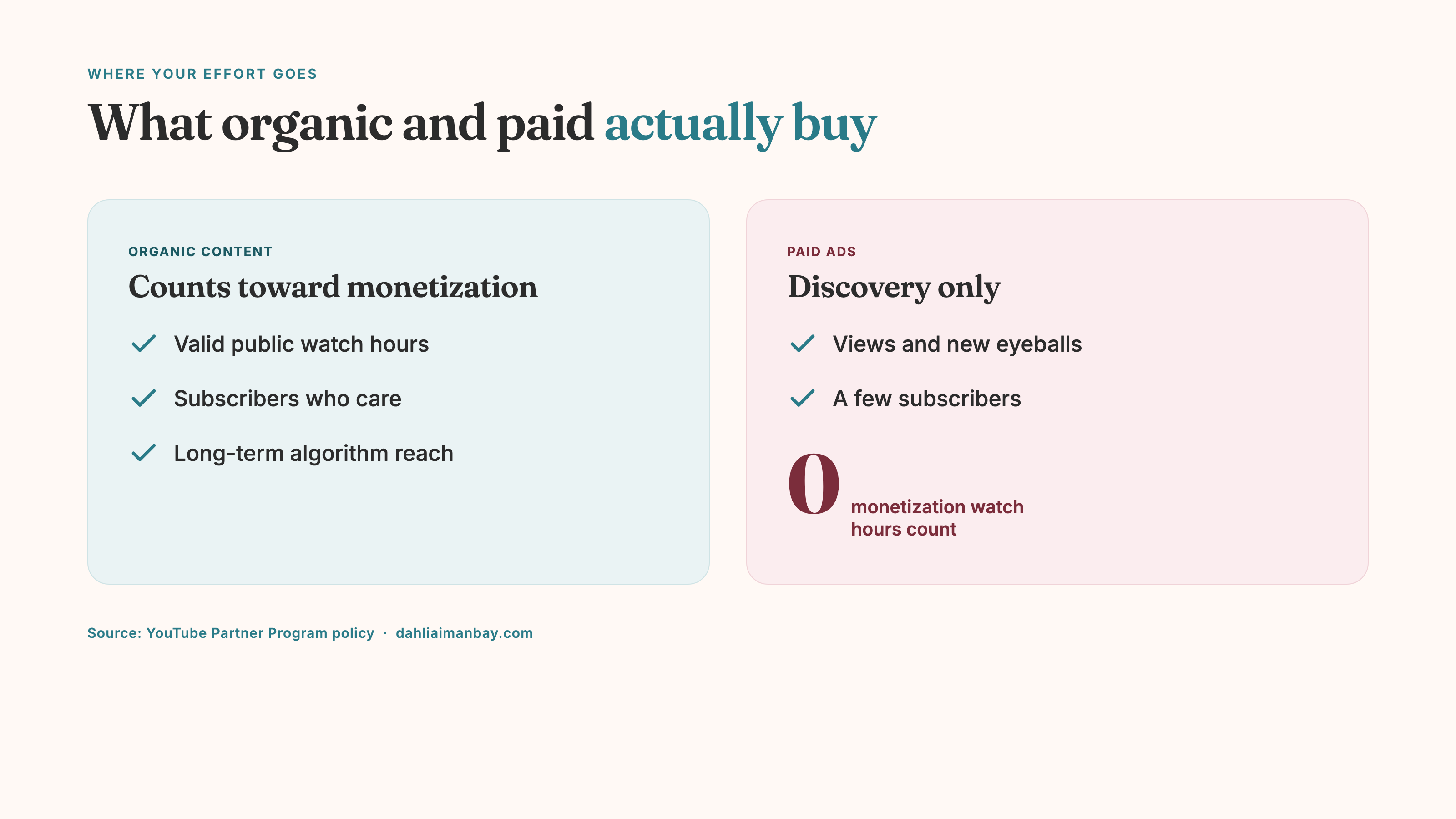
Once that clicked, the whole strategy reorganized itself in my head. Money cannot shortcut the 4,000 hours, so I stopped trying to make it. Organic content is the only thing that builds monetizable watch time, which means that is where the real work goes. Paid ads still have a place, but a narrow one: discovery. An ad can introduce your channel to someone who then subscribes and watches your other videos organically, and those later hours count. The ad view itself does not. That distinction is the entire game.
Organic: the only thing that builds monetizable hours
This is where I spend most of my energy now, for my own channel and for the brands I advise, where my agency runs the same organic-plus-paid split for client channels. None of it is a trick. It is a system you run on repeat.
- Publish 8 to 12 minute videos in niches your audience already loves. Look at your own best performers, understand why they worked, and make more like them. Your analytics are a content brief you already paid for.
- Repurpose your top Shorts into long-form. A Short that popped is proof of interest. Turn it into an extended tutorial or a story-style video and you are building on demand you have already seen.
- Open strong and keep them to the end. A clear hook in the first 30 seconds, a reason to watch to the finish, and an end screen that points straight at the next video. Chaining one view into the next is how watch hours actually add up.
- Build themed playlists with Play All. Playlists turn a single view into a binge session, which raises watch hours per viewer without you making a single extra video.
- Go live now and then. Q&A sessions, tutorials, behind-the-scenes streams. Livestreams pull in meaningful watch hours because people stay for much longer than they do on a standard upload.
- Do the boring SEO. Optimize titles, tags, and descriptions with tools like TubeBuddy or vidIQ, the same front-loaded-keyword approach I used when I tested three short-form video SEO hacks. Front-load your keywords, and mix trending topics with evergreen ones so you get a spike now and a slow drip later.
- Post 2 to 3 quality Shorts a day. Trending sounds, captions in the first seconds, and a clear path to your long-form. Shorts are your top-of-funnel; long-form is where the watch hours live. (If Shorts are genuinely your format, the 10 million views in 90 days path is a real alternative.)
Paid ads: for discovery, and nothing else
I still run ads. I just ask them to do the one thing they are good at, which is finding new humans. When discovery is the goal, here is how I set them up.
- Use a Video views campaign, not Demand Gen. Video views serves skippable in-stream, in-feed, and Shorts placements and is built around getting the video watched. Demand Gen chases clicks and conversions, which is why mine returned about 5 watch hours.
- Target with custom segments. Under Tools, then Shared library, then Audience manager, then Custom segments, you can target people who searched for a similar creator or competitor by name, or who browse competitor sites. That is far warmer than broad interest targeting.
- Serve on Shorts with mobile-only targeting. Upload a 9:16 vertical video under 60 seconds as a Short and point the campaign at mobile. Vertical, native, cheap.
- Study competitors in the Google Ads Transparency Center. You can see the live ads other channels are running, including their thumbnails and messaging. Free competitive research.
- Warm cold audiences first. Run a video-views campaign before any conversion campaign so the algorithm learns who actually watches you. Then it has data to work with.
One more thing I watch closely: judge an ad on retention and average view duration, not on raw view count. A big cheap view count made of people who bounce in three seconds can actually hurt your organic reach, because YouTube reads that low retention as a signal the content is weak. I would rather pay for 500 people who watch most of the video than 5,000 who leave immediately.
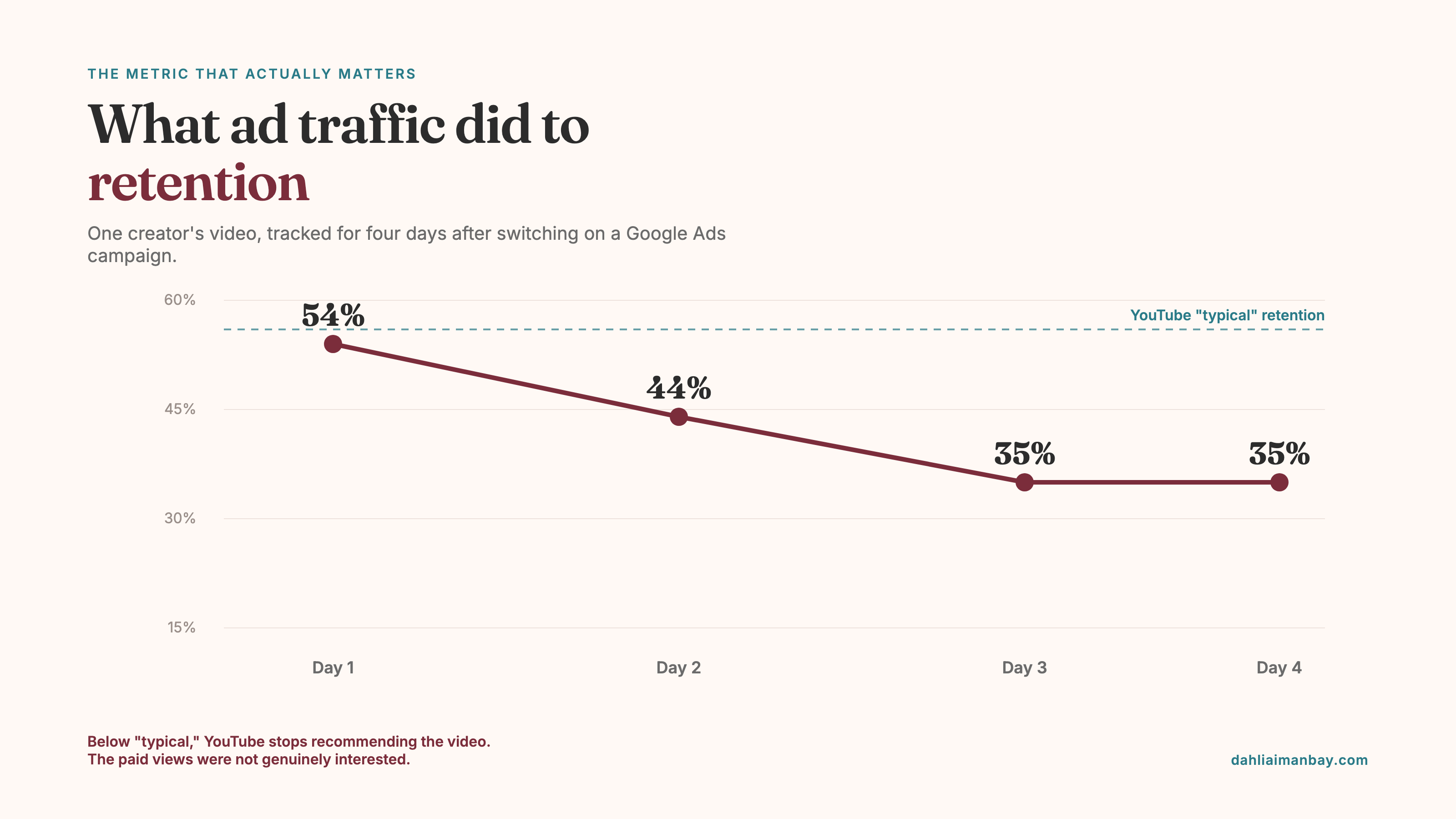
- The view counter looked great. One creator who documented the experiment promoted a video with a Google Ads Video views campaign, and views jumped from about 300 to 1,200 in four days.
- Retention told the real story. It fell from 54%, YouTube's typical mark for that video, to 44% on day two, then to about 35%, below typical, on days three and four, because the paid traffic was not genuinely interested.
- The first 30 seconds are the decision window. When retention drops there, YouTube reads it as viewers not caring, and the video can get buried in the algorithm.
- It was not a total loss. She still gained 6 subscribers from the campaign, double the 3 she had from organic.
- Her honest conclusion. The campaign hurt the video more than it helped, because views without interest do not build a channel. That is exactly why I judge ads on retention and genuinely interested viewers, not the raw view counter.
"I'll just buy my way to monetization."
You cannot. Paid views are real views, and they can grow your audience, but they are excluded from the 4,000-hour bar by YouTube's own rules. Only organic watch time counts. Anyone selling you a shortcut to the Partner Program is selling you hours that will not qualify.
The budget math that surprised me
Here is a small, expensive detail I did not expect. When you set a "$5 a day" budget in Google Ads, that is not a $150 month and it is definitely not a $100 month. Google can spend up to your daily budget multiplied by 30.4 in a given month, to make up for slower days. So a $5 daily budget can bill you up to about $152 a month.
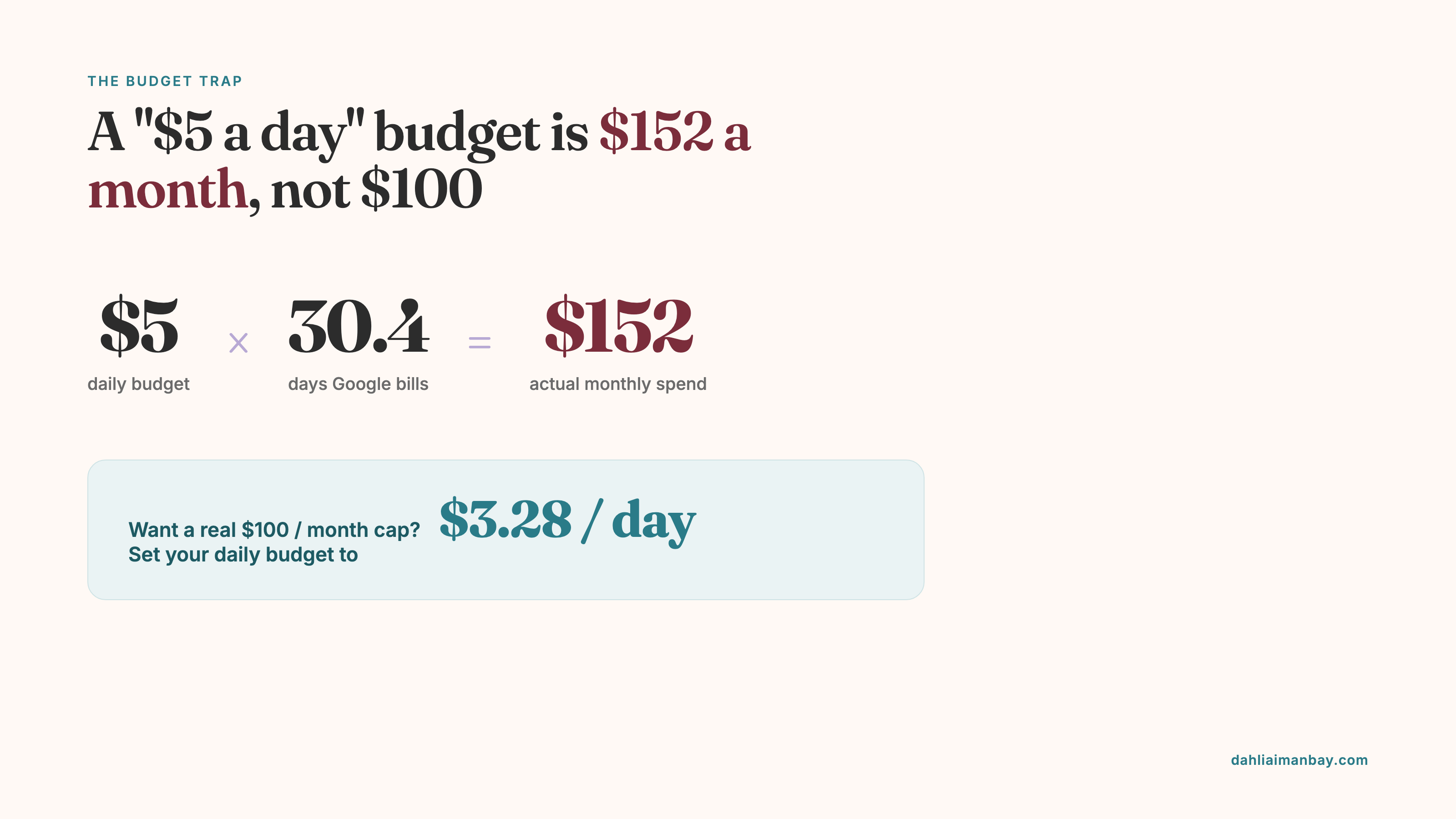
It is a tiny number that quietly changes your real spend by half again. If you are testing ads on a small budget, set the daily figure from the monthly cap you actually mean, not the round number that feels right.
Organic builds the hours that make you money. Paid ads buy attention, not eligibility. Keep those two jobs separate and you stop wasting money on the wrong one.
The takeaways, in one place
If you want the deeper version of the discovery side, the same custom-segment and competitor-research thinking shows up in how I approach getting found by AI search. Different channel, same principle: build something worth finding, then make it easy to find.
Frequently Asked Questions
No. To join the YouTube Partner Program you need 1,000 subscribers plus 4,000 valid public watch hours in the past 12 months (or 10 million valid public Shorts views in 90 days). Watch time from Google Ads or other paid promotion is explicitly excluded and does not count toward that 4,000-hour threshold. Only organic watch time qualifies. Paid ads can bring new viewers who then watch you organically, but the promoted watch time itself does not count.
Demand Gen campaigns optimize for clicks and conversions, not watch time. When I ran one for my own channel it produced only about 5 watch hours while still spending budget. If your goal is watch time and reach on the video itself, a Video views campaign (skippable in-stream, in-feed, and Shorts) is the right campaign type, not Demand Gen.
Google Ads can spend up to your daily budget multiplied by 30.4 in a month, so a $5 per day budget can bill up to about $152 per month, not $100. If you want a hard $100 monthly cap, set your daily budget to about $3.28.
Publish 8 to 12 minute videos in a niche your audience already watches, study your own best performers and make more like them, chain views with Play All playlists, run occasional livestreams, and post 2 to 3 quality Shorts a day that funnel viewers to your long-form. There is no paid shortcut; the hours have to be earned organically.
Sources & Credit
- YouTube Help. YouTube Partner Program overview & eligibility, the primary source for the 1,000 subscriber and 4,000 valid public watch hour requirements.
- Google Ads Help community, on ad-generated watch time being excluded from Partner Program monetization thresholds.
- Google Ads Help. How daily budgets work, on monthly spend reaching up to the daily budget multiplied by 30.4.
- Tactics credit to creators sharing paid-discovery approaches openly, including Promogod, Ric Zog Digital, and DCYPHER Studios.