The short version: I kept seeing free SEO hacks on TikTok, so instead of scrolling past, I ran three of them on my own two websites in one afternoon. The first showed me the exact questions people Google to find me. The second turned those questions into answers. The third pointed Google to the pages I actually want people to reach. Below are the steps, the real data, and the one thing that genuinely surprised me. I am not an SEO expert. That is the point.
I build AI systems for a living, but search has never been my home turf. So when a creator named @chitchat.marketing kept showing up in my feed with free SEO hacks, I did the thing I usually tell other people to do: I stopped watching and actually tried them. On my own sites. In an afternoon. Here is exactly what happened, in plain language, so a nonprofit lead or a small business owner could follow along.
The three hacks, in one line each
Before the details, here is the whole thing so it makes sense as you read:
- Hack 1: Find the exact questions people type into Google to find you.
- Hack 2: Answer one of those questions on your page, word for word.
- Hack 3: Add links from your other pages to the page you want people to reach.
All three are free. None need code you have to understand. Let's start with the one that opened my eyes.
How do you find the exact questions people Google to find you?
You use a free Google tool called Search Console. It quietly records every search that showed your website, and most people never open it. The trick that makes it useful in two minutes: filter that list down to only the questions.
- Search "Google Search Console" and add your website. It is free.
- Open the tab called Performance. This is every Google search that showed your site.
- Open ChatGPT or Claude and ask, in plain words, for the code that shows only the questions people searched. It gives you a short line of text. You do not need to understand it, just copy it.
- Back in Search Console, click Add Filter, click Query, choose the "Custom" option, and paste it in.
- What is left is the real list of questions people ask that already show your site.
When I did this, I got a list I did not expect. And one column stopped me cold.
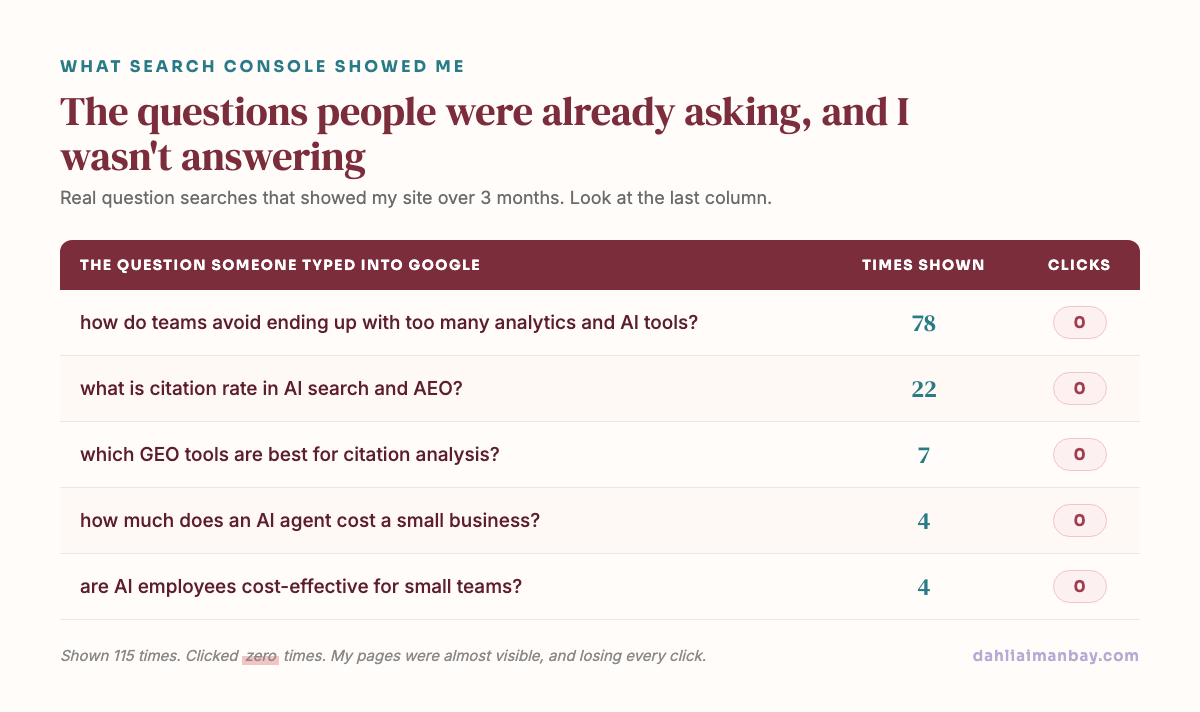
Real people were typing these exact questions. Google was showing them my pages. And not one of them clicked. That gap is the whole opportunity, and it leads straight into the second hack.
How do you turn those questions into content AI will actually quote?
Here is the embarrassing part: people were asking questions I had sort of answered, but never directly. So I fixed it, and it took about two minutes per question.
- Take one real question from that list.
- Add it to the right page as a heading, worded exactly how people typed it.
- Answer it in the first two sentences. Short and clear. No long wind-up.
That last rule matters more than it sounds. When someone asks ChatGPT or Google's AI a question, the answer gets pulled from short, self-contained sentences. If your answer is buried three paragraphs down, it gets skipped. If it is the first thing under a clear question, it can get lifted straight into the answer. This is the heart of what people now call answer engine optimization, and I go deeper on it in how to get cited by AI search.
I did this on the pages that were already being shown: the one about too many AI tools, the one about what an AI agent actually costs, and the AEO one above. Each got the exact question added as a heading with a two-sentence answer.
How do you make a page Google already shows actually get found?
The third hack is the easiest, and somehow the one nobody does. It is called internal linking, which just means linking from one page of your site to another. It tells Google which page is the important one for a topic.
- Pick the one page you want people to reach. A donate page, a service, a key article.
- Go to Google and type: site:yourwebsite.com "your keyword" (with the quotes).
- Google lists every page on your own site that mentions that keyword.
- On those pages, add a link to the page you want people to reach. Use natural, varied wording, not the same phrase every time.
Eight genuinely useful links beat thirty forced ones. If a link would feel awkward to a reader, skip it. Google is good at spotting the difference now.
I added a small handful of these, each in a sentence that already existed, each pointing at a page I had just improved. No new writing, maybe fifteen minutes.
What surprised me
Three things I did not expect, and one of them is a lesson for anyone doing this.
My pages were almost visible, and losing every click. Being shown 115 times and clicked zero times felt worse than not showing up at all. It meant the raw material was there; I just was not finishing the job by answering the question clearly.
The "problem" I feared was mostly a mirage. I worried a bunch of my pages were competing against each other for the same words. When I actually looked, most of the overlap was just category labels, not real competing content. I almost "fixed" a problem I did not have. Look before you touch anything.
My sitemap was quietly broken. While poking around, I found the map that tells Google about my pages was badly out of date: it listed 11 pages when I had over 40. Some of my newer posts were basically invisible to Google through no fault of the writing. A five-minute fix, and a good reminder to check the boring plumbing.
If you do one thing this week
Here is the only prompt you need for the first hack. Paste it into ChatGPT or Claude:
Write me a short filter (a regular expression) that keeps only search queries that are questions, meaning they start with words like how, what, why, where, when, which, who, can, should, or do. I will paste it into Google Search Console's custom query filter. Give me just the line of code and one sentence on where to paste it.
Give the whole thing a couple of weeks. Search takes time to catch up. But the questions are real, the fixes are free, and the hardest part was simply opening the tool.
Frequently Asked Questions
Use Google Search Console, which is free. Open the Performance report, then filter the Query list to show only questions. The fastest way is to ask an AI assistant to write you a small filter that keeps only question-style searches, then paste that into Search Console's custom query filter. What is left is the real list of questions people type that already show your website.
It usually means the page ranks low (around the third page of results) or the answer is being read straight from an AI summary, so no one needs to click. In my own data, several pages were shown for real questions but earned zero clicks at an average position of 26. The fix is to answer the exact question clearly on the page so it can rise and get quoted.
An internal link is a link from one page of your site to another page of your site. When several of your pages link to one target page using natural, varied wording, you signal to Google that the target is the important page for that topic. It is free, it takes minutes, and it is one of the most overlooked ranking moves for small websites.
No. I am not an SEO expert and I ran all three in one afternoon. Each one is free, uses tools you already have (Google Search Console, an AI assistant, and your own website), and needs no code you have to understand. You copy and paste what the AI gives you, answer real questions in plain language, and add a few links.
Sources & Credit
- The three hacks are adapted from @chitchat.marketing on TikTok, who shares free DIY SEO tips.
- AirOps. (2026). Answer Engine Optimization: Your Complete Guide for 2026, on question-style headings and citation.
- All figures are from my own Google Search Console data across two of my websites, over three months. Results may vary by site, topic, and starting point.

Want the business and agency version?
We Ran 3 Free SEO Hacks on Our Own Site: The Process and the Data
The same experiment written up as a repeatable process for teams, on my agency site.