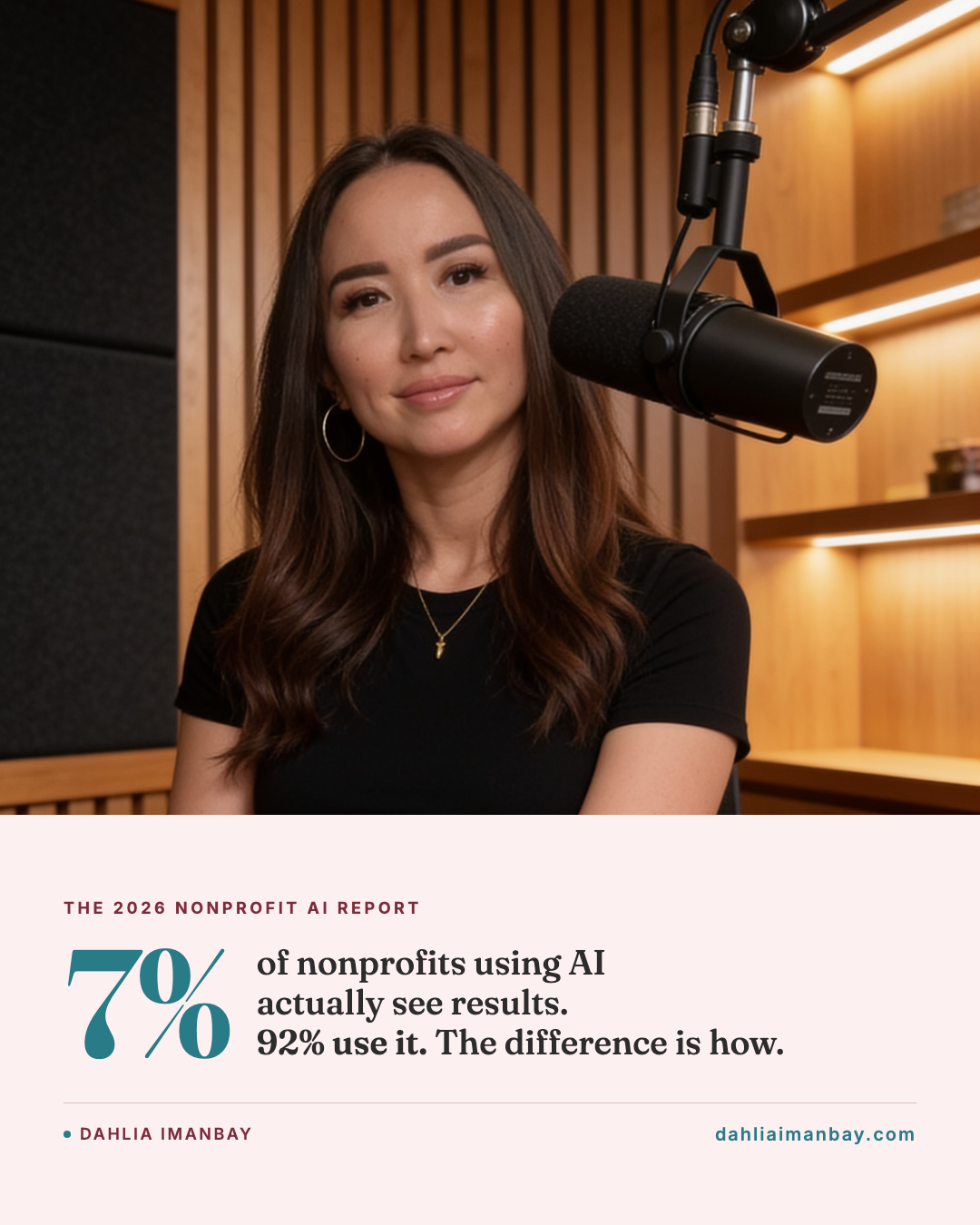
92% of nonprofits use AI but only 7% say it changed anything, largely because 81% use it individually. The organizations that see results take one repeated task, define one good way to do it with AI, and have the whole team follow it. The gap is shared process, not better tools.
A study landed this month that I have not been able to stop thinking about. Virtuous and Fundraising.AI surveyed 346 nonprofits about how they actually use AI. The headline number sounds like good news: 92% of them are using it. Then you read the next line. Only 7% say it has meaningfully changed what their organization can do.
I have seen that gap up close, in real organizations, all year. So here is what is actually happening, why most teams get stuck, and the one thing the 7% do differently. None of it requires a bigger budget or a better tool.
Adoption is not the same as impact
The temptation is to read "92% are using AI" as "the sector has figured this out." It has not. Almost everyone has opened ChatGPT. Almost no one has changed how their organization runs because of it. And the reason is in that third number: 81% are using AI individually. One person, quietly, on their own. Useful, but invisible to everyone else, and gone the moment that person is busy or leaves.
Where most teams go wrong
Most organizations treat AI like a personal productivity trick. One person gets faster at one task. The rest of the team works exactly the way they did before. So nothing changes at the level that matters. You do not get a faster organization; you get one person typing faster, in a corner, while the same bottlenecks sit untouched everywhere else.
- One person improvises with AI on their own
- No shared, written-down way of doing it
- Knowledge leaves when that person does
- The same bottlenecks stay in place
- One repeated task, done one good way
- The whole team follows the same process
- The knowledge lives in the system, not a person
- A real bottleneck actually disappears
What the 7% do differently
Here is the whole difference, and it is almost boringly simple. The organizations seeing real impact took one task the team does over and over, figured out the best way to do it with AI one time, and then everyone started doing it that same way. Not a fancier tool. One repeated task, one good way of doing it, used by the whole team.
One good shared process beats ten people each typing prompts alone.
Where this gets hard
I want to be honest, because this is the part most "AI for nonprofits" advice skips. Turning a private shortcut into a shared way of working takes effort the first time. Someone has to write the process down. The team has to agree to follow it. And the report found something worth sitting with: 47% of nonprofits have no AI policy at all, which means no agreement on what is even safe to put into these tools. That matters more in our world; if you work anywhere near health or sensitive data, one person improvising is not just ineffective, it is a risk.
What I would do this week
If you want to be in the 7% this year, do not buy anything new. Pick one task your team repeats every single week. Write down the best way to do it with AI, in plain language a new hire could follow. Then have the whole team use that one version. Prove it works, then do the next one. This is the same discipline behind protecting a small team's capacity: redirect effort, do not just add tools.
The 81% trap, in detail
It is worth staying on that 81% figure, because it explains almost everything. When AI lives in one person's browser tabs, three things happen. The knowledge never gets written down, so it cannot be improved or handed off. The rest of the team keeps working the slow way, so the organization as a whole does not speed up. And the moment that one person is on leave or moves on, the capability walks out the door with them. You did not build anything. You rented a shortcut.
A shared process flips all three. The best way to do the task gets documented, so it can be refined over time. Everyone runs it, so the whole organization moves faster, not just one person. And the capability lives in the system, so it survives turnover. That is the difference between using a tool and building a capability.
A 30-day plan to join the 7%
You do not need a strategy deck. In week one, pick the single task your team repeats most that produces nothing strategic, and watch how it is done today. In week two, work out the best way to do it with the AI you already have, and write it down in plain language a new hire could follow. In week three, have two or three people run that exact process and fix whatever is unclear. In week four, make it the default, and only then look at the next task.
One task, done one good way, used by everyone. Prove it, then repeat. That is the whole method, and it is the reason the 7% pulled ahead while everyone else was still opening new tabs.
Key Takeaways
- ✓Adoption is not impact: 92% use AI, only 7% see it change anything.
- ✓The gap is shared process, not better tools; 81% use AI alone.
- ✓Pick one repeated task, document one good way, and have the whole team use it.
- ✓Write an AI policy; 47% have none, which is a real risk near sensitive data.
Prefer the business and agency angle? Read the AI Powered Dahlia version.
Frequently Asked Questions
Because adoption is not impact. 92% use AI but only 7% say it changed anything, largely because 81% use it individually. One person gets faster while the rest of the team works the old way, so the organization does not actually change.
They take one task the team repeats, figure out the best way to do it with AI once, and have the whole team follow that same process. The knowledge lives in a shared system, not in one person's head.
Yes. 47% of nonprofits have no AI policy, which means no agreement on what is safe to put into these tools. For any organization working near health or sensitive data, a written, shared process is both more effective and safer.
Do not buy a new tool. Pick one weekly repeated task, document the best way to do it with AI in plain language, and have the whole team use that one version. Prove it, then repeat with the next task.
Sources
- Virtuous & Fundraising.AI (2026). Nonprofit AI Adoption Report (survey of 346 organizations).
- Originally shared on my Substack: Everyone is using AI. Almost no one sees results.

Want AI that actually changes how your team works?
I help mission-driven organizations turn one repeated task into a shared, documented AI process that the whole team uses, the difference between the 92% and the 7%.
Get in Touch